Project III
2004
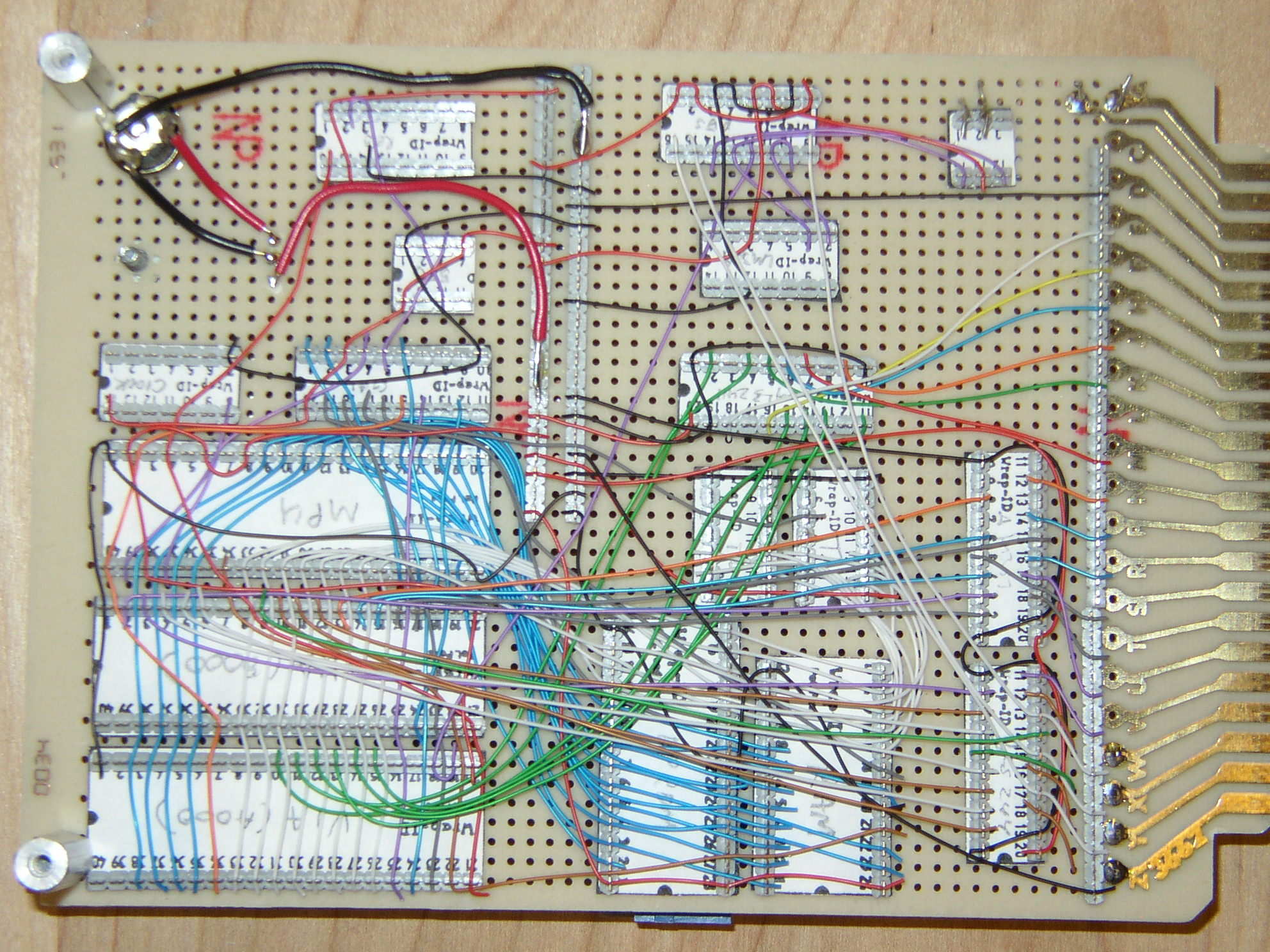
For my microprocessors and controls class at Princeton (affectionately known as Trains), the underlying motivation was to learn how computers work together with various other mechanisms to provide control of dynamical systems. The actualization of this goal came through model train systems and took a good deal of creativity, engineering finesse, and time. My partner was Miss Jennifer (the best partner ever!) and we began by first laying out, wiring, and building a computer. We built a sample one on a breadboard and then tediously wired a much more compact version.
 |
 |
After that we needed to come up with a challange and method of solving it. We decided on 'Apples and Oranges' - the we devised two types of objects ('apples' and 'oranges') where were located in bulk at two distinct locations. Each type of item was transported via train car and would undergo two different processes - i.e. that of sorting the objects as they arrived and that of loading the objects for departure. Sounds simple, right? Well, first we had to do a track layout and decided on a figure eight style of loops connected by a straight track at the top. In the center is a mechanical arm with a carefully-fashioned protrusion for loading the objects onto the train, and a magnet affixed to the other side for picking objects up off trains ready to unload. One loop held the surplus of apples as well as the apple loading dock, and the other loop held the same for the oranges.
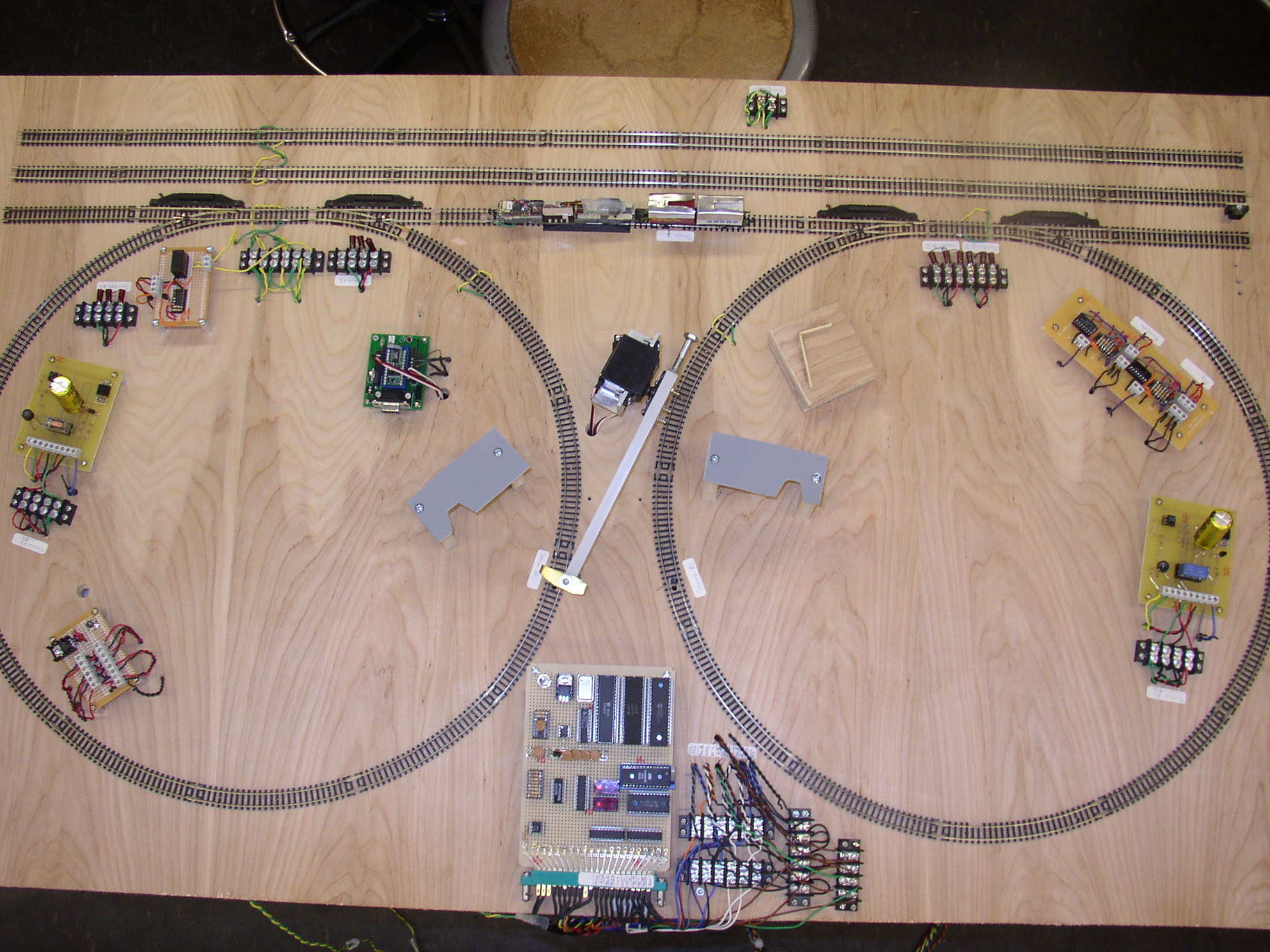 |
A train entered the track from the top right on the straight track and
passed by a detector which determined whether the train was carrying apples, oranges, or nothing (we distinguished the items by
self-fashioned bar codes with a relfecting and absorbing pattern). If the train was empty, it continued straight to the middle
where it stopped at a precise location and waited for loading. While it was stopped, the arm in the middle would swing over to
the appropriate location (whether we had specified that apples or oranges were to be picked up on that pass), picked up the proper
crate with an elegant sliding motion, and loaded it onto the train which then sped away. If it was detected that the train needed
to be unloaded, then the rail were switched so that the train entered the correct loop, the train was stopped at a precise location,
the arm swooped down and the magnet grabbed the object, lifted it up from the train, and deposited it next to the silo.
 |
 |
 |  |
The class was really a lot of fun, but it was hard work and required us to code the EPROMs in machine language, program and control the servo arms, properly wire and positions the hall effect and optical sensors and, of course, learn how to find very tiny broken wires when the computer stopped working. If anyone is interested, more information along with a movie can be found at the Princeton MAE 412 webpage by scrolling down to 2004 and clicking on "Joel and Jen"!