Investigation of Uniform Plasma Channel Generation for Short Laser Pulse Amplification
2004-2005
For my senior thesis I worked with Prof Szymon Suckewer in the applied physics part of the Princeton MAE department. After having
taken a class in plasma physics, and having a burgeoning interest in lasers, I decided to work with the Princeton High Power Laser Lab on
a project which combined both of these interests. Lasers, in particular, have become ubiquitous in our everyday life - from laser pointers to
writing and reading cds to helping you scan things in the grocery checkout line, lasers show up everywhere. In a scientific context, lasers
are composed of light which is all one color (i.e., monochromatic) which can perform tasks which other types of light cannot. Recently, though,
physical limitations have constrained the development of lasers beyond certain output powers - I my research, I pursued a technique that
circumvented the traditional limiting mechanisms (mainly material breakdown) by using plasmas. A plasma (not like the type in your blood) is
described as the fourth state of matter and is composed of ionized particles (think of it like a gas except that instead of neutral atoms flying
around, you have separate electrons and ions which produce strange behaviour because of their electrodynamic interactions). While you may think
that plasmas are only found in stars or in physics labs, I would like to point out that plasmas show up as lightning, fluorescent lamps,
and the Northern Lights.
 |
 |
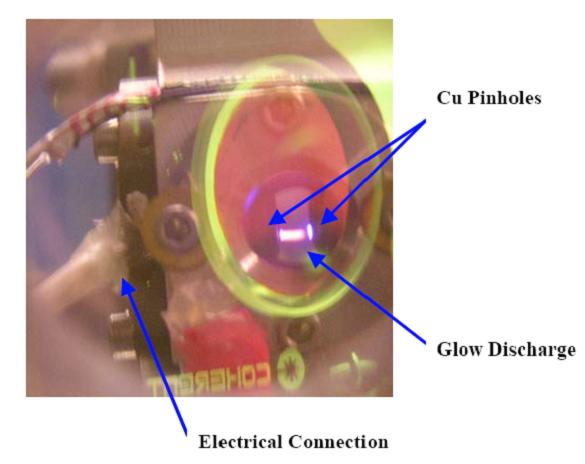
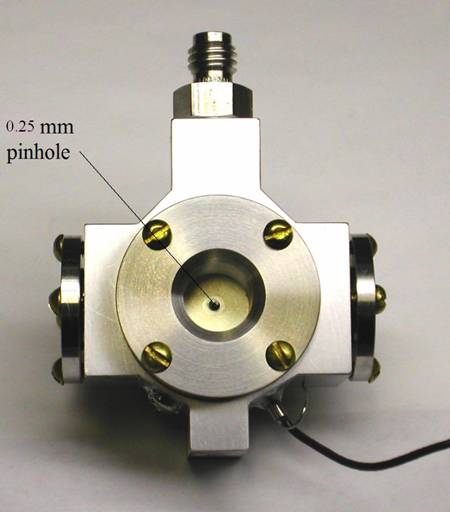
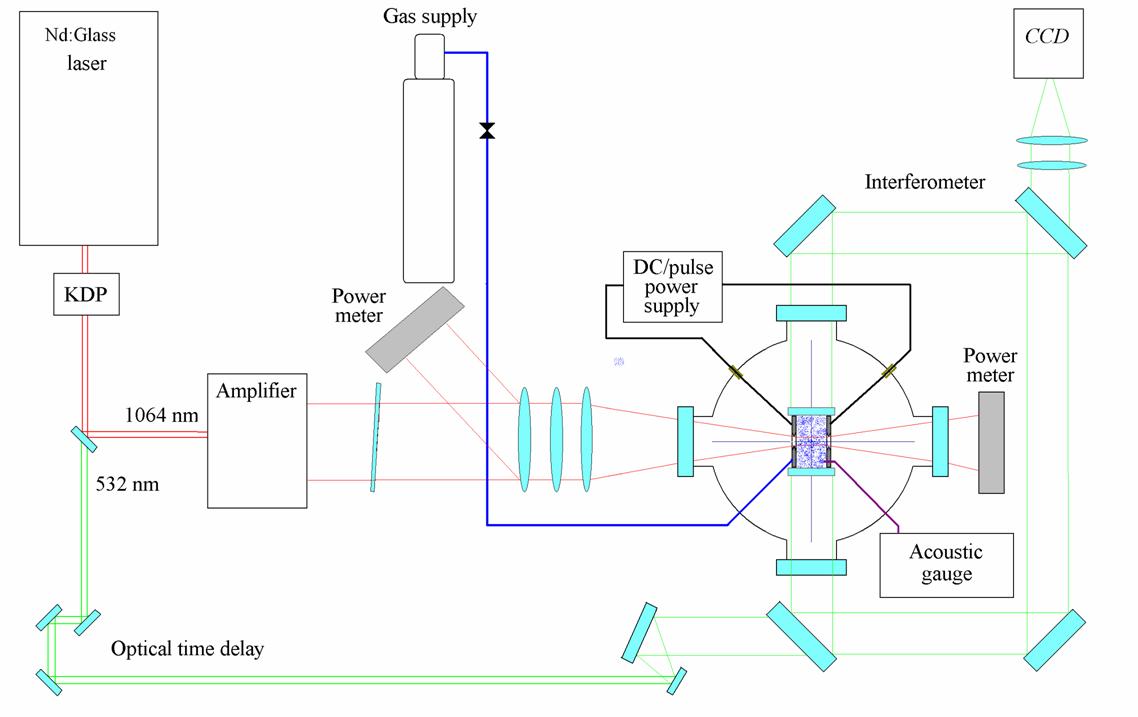
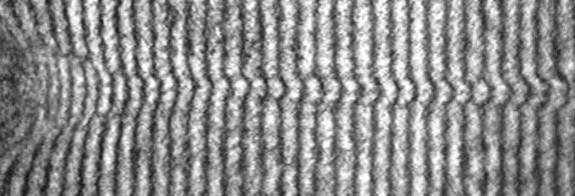
My job was to make a plasma channel (a cylinder of plasma) that was very long and uniform so that the greatest amount of energy could be transfered from the plasma to the laser. The setup that I used was a metal cell placed inside a vacuum chamber. Along the axis of the main laser, two tiny pinholes were made in a piece of metal to allow the laser to pass through the cell. The metal was then connected to a high voltage source and, when the laser pulse passed between the metal pinholes, a voltage was applied to the pinholes which produced a discharge plasma (like when you touch a doorknob after dragging your socks on the carpet). A component of the laser was split off before this point and used for diagnostic inteferometry via a Mach-Zender interferometer to quantify the plasma produced. Pictures of the laser, plasma (the pink thing in the cell), and the rest of the setup are shown below. Also, a full version of my SENIOR THESIS can be viewed by clicking the link. The work was published in the journal Physics of Plasmas - Formation of Laser Plasma Channels in a Stationary Gas
 |
 |
 |
 |
 |
 |