


Capacitive impedance is
 , which means that,
for a given AC frequency
, which means that,
for a given AC frequency  , a large capacitance means a smaller
impedance (i.e., more current for a given voltage according to the AC
Ohm's Law,
, a large capacitance means a smaller
impedance (i.e., more current for a given voltage according to the AC
Ohm's Law,
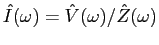 ). Here's the qualitative
explanation: if you have a very large capacitance, that means a lot of
charge can be stored for a given potential difference, and the
capacitor takes a long time to charge up. In an AC circuit, current
only passes through a capacitor during the time a capacitor is either
charging or discharging. If a capacitor is fully charged or
discharged, it acts like an open circuit and does not pass current--
its impedance is infinite. A large capacitance means that (for a
given of AC driving voltage) the capacitor will spend more of
its time in a charging or discharging mode. A small capacitance means
that the capacitor will charge up quickly and spend most of the cycle
behaving like an open circuit and so not passing current.
). Here's the qualitative
explanation: if you have a very large capacitance, that means a lot of
charge can be stored for a given potential difference, and the
capacitor takes a long time to charge up. In an AC circuit, current
only passes through a capacitor during the time a capacitor is either
charging or discharging. If a capacitor is fully charged or
discharged, it acts like an open circuit and does not pass current--
its impedance is infinite. A large capacitance means that (for a
given of AC driving voltage) the capacitor will spend more of
its time in a charging or discharging mode. A small capacitance means
that the capacitor will charge up quickly and spend most of the cycle
behaving like an open circuit and so not passing current.
Similarly, for a given  , a fast driving wiggle will mean that the
capacitor is constantly charging-discharging-charging-..., and so
passes more current on average (so has low impedance). In contrast, a
small will mean that the capacitor has a chance to charge all
the way up or discharge all the way down, and so will be
open-circuit-esque during much of the cycle, and hence won't pass much
current (so has high impedance).
, a fast driving wiggle will mean that the
capacitor is constantly charging-discharging-charging-..., and so
passes more current on average (so has low impedance). In contrast, a
small will mean that the capacitor has a chance to charge all
the way up or discharge all the way down, and so will be
open-circuit-esque during much of the cycle, and hence won't pass much
current (so has high impedance).
Both the size of and matter; impedance is related to the product of them.