


 field is either up or down [along the inductor]). So how exactly can the inductor resist the change?
Right, you get a circular magnetic field around a straight current-carrying wire and a magnetic field along the axis of an ideal solenoid, in both cases described by the right hand rule (in the former case, the fingers curl in the direction of the field; in the second case, the fingers curl in the direction of the current.) This is an idealization; in real life, the solutions to Maxwell's equations describing the field induced by a current will have continuous transition regions going from one geometry to another.
As for resistance to change: what matters is change in current and magnetic field, not the current and magnetic fields themselves.
The back-emf results from the change in current, and
opposes that change. In either
case, if there's a  , there will be a potential
 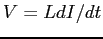 which resists
the change, e.g., if the current is increasing, the inductance will be responsible for
a back-emf that opposes that
increase (workds to decrease the current). If the current is decreasing, the inductance
will be responsible for a back-emf that works to increase the current. This happens for
either a wire or a solenoid (or anything), but we treat the idealized wire as having zero
inductance. We consider only the solenoid, which will develop a back-emf to decrease
an increasing current, and increase a decreasing current.
which resists
the change, e.g., if the current is increasing, the inductance will be responsible for
a back-emf that opposes that
increase (workds to decrease the current). If the current is decreasing, the inductance
will be responsible for a back-emf that works to increase the current. This happens for
either a wire or a solenoid (or anything), but we treat the idealized wire as having zero
inductance. We consider only the solenoid, which will develop a back-emf to decrease
an increasing current, and increase a decreasing current.